Saturday, 21 July 2012

WORKS IN PROGRESS

Sacrificing Pelicans to Petroleum Gods

I am sat watching BBC News 24 as I am writing. I have a wry smile on my face as the Olympic torch reaches the Westfield Shopping Centre, Stratford, East London. What a free advertisement for an Australian company! I have a wry smile, as I am preparing for an exhibition that will be held in a shopping centre (or Mall) in Shepherds Bush, West London. Although Westfield have one of their monstrous cathedrals to unfettered consumerism here, not for us De Beers, Gucci or Louis Vouiton, in the Designer Village, nor  indeed House of Fraser or Waitrose. We will be hanging out with the likes of Poundland, Cash Converters, Super Drug and Morrissons at the West 12 Centre (previously known as the Concord Centre) across the road in Shepherds Bush Green. 

Maybe I'm an inverted snob, but Morrissons and Poundland are where I do my shopping. My local pub is Belushie's on the Green, and I will be proud to be exhibiting there alongside Turner Prize winning artists (more information to follow) in a venue connected to the local community.

Having had my rant for the day, and having set the picture, I thought that I would share with you a couple of pieces that I am working on, to give an idea of the type of art work I do, and some of the processes involved, (although I will do a step by step posting on 'how to etch a shell casing' at a later date).

Stock picked up in France

I mentioned a while back that I had not long returned from a buying trip to France, and some of you may have seen the Trench Art that I have been selling since I returned.This, however is only part of the story, as I used the trip to pick up blank shell casings for me to etch, three of which I will look at here.

Different patina of blank shell casings

As can be seen in the photograph above, the shell casings come in various sizes, and in various states of surface degradation. After choosing the most appropriate shell, I then spend many hours polishing, cleaning and degreasing the surface ready to transfer my image to it.


Transferring the image for:
'The White Rose'

After tracing my image, I use masking tape to attach the tracing paper with carbon paper behind, as can be seen in the above photographs. The image is then transferred using a ballpoint pen or hard pencil. Once this is done I paint over the image with 'sugar lift', or a super saturated sugar and water solution with pigment added. This is commercially available from Printers Suppliers, however I have made my own in a 'one portion' jam pot by adding water and a small amount of water colour paint to sugar. There needs to be just enough sugar and water in the solution to just desolve the sugar. I will cover this further when I do the suggested post on the processes and techniques required to etch a shell casing.


Design painted in Sugar Lift

The shell casing is then varnished with 'straw hat varnish' (available from Intaglio Print Makers Suppliers, London). When dried, a kettle full of hot water is poured over the sugar lift, dissolving it, and revealing the design to be etched. After this and at other points in the etching process, I would add various degrees of fine detailing using a sharp tool to scratch into the varnish.

My preferred mordant for etching is a solution (active etching agent) of Copper Sulphate, Table Salt and Water, rather than the more traditional use of Acids utilised by other etchers and printers.

Partially worked etched shell casing
'Sacrificing Pelicans to Petroleum God's'

Photograph illustrating the depths of etched
lines and surfaces
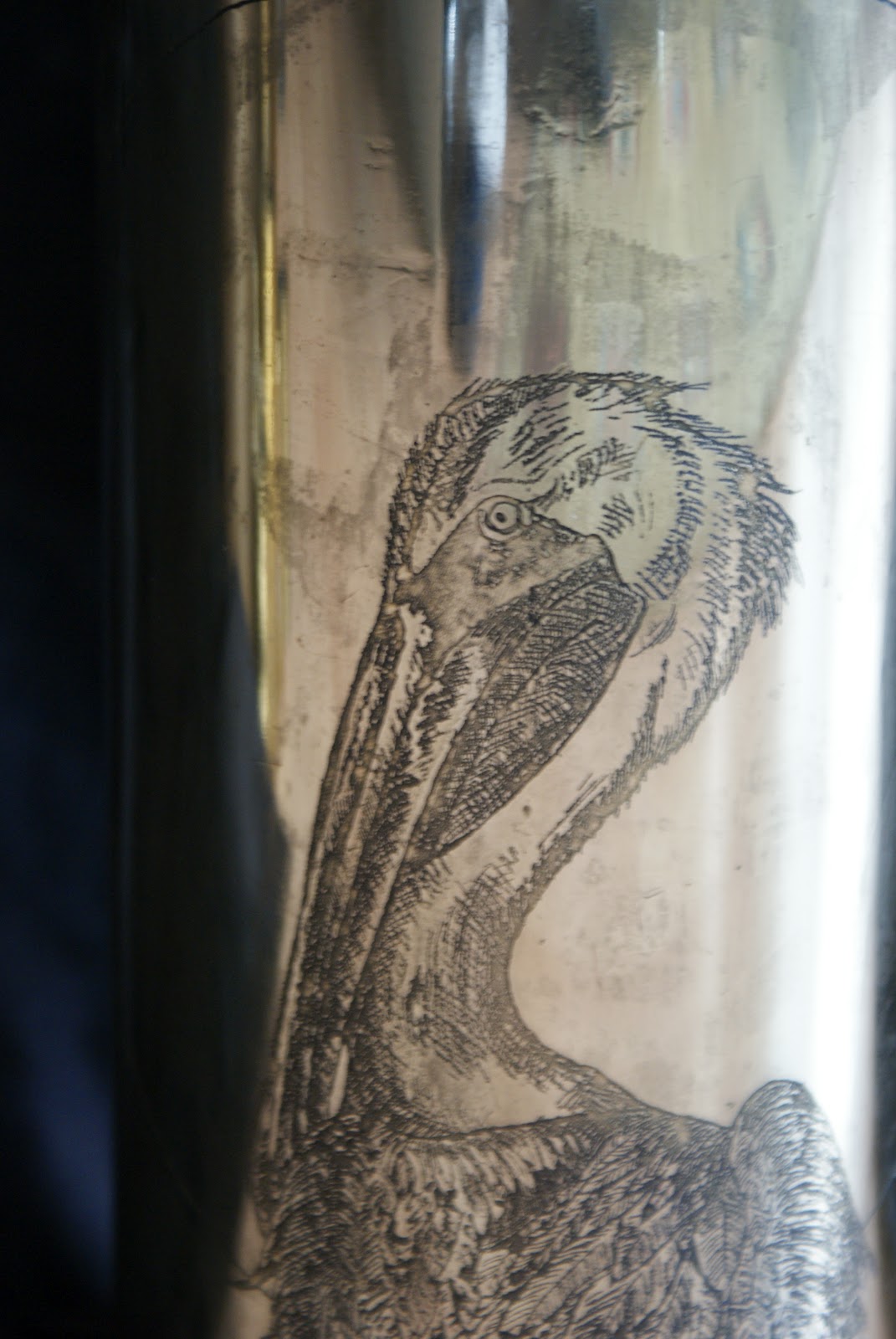

Details of the etched image

There is still a lot of work to be done on both of the shell casings to get them to exhibition standard within the next few weeks. Each casing alone can take a month to produce, the etching itself being only a small proportion of this time.

To research the subject matter alone can be weeks of work in itself, however, this is as much a part of the artwork as the physical object  and image.

I will go further into the subject matter of both of these works once they are finished, however the inspiration for 'Sacrificing Pelicans to Petroleum Gods' is a report on the Deep Water Horizon disaster in the Gulf of Mexico, and a report of the same name, which can be viewed by following the link below:


The White Rose is a youth organisation in Germany which challenged the might and authority of the Nazi Government during WWII. For their opposition and bravery, six members of the organisation were executed by being beheaded. This is my tribute to them. Again, once finished I will do a posting specifically on the piece, but for those who would like to read a little about them now, follow the link below to Wikipedia:


We will not be silent.
We are your bad conscience.
The White Rose will not leave you in peace.

(Motto of the White Rose Resistance Movement)

Nick Hockenhull's Ironman Challenge

Please donate to Nicks' sponsored challenge for UNICEF at the link below if you can!


Nick Hockenhull's Ironman Challenge main photo

appeal image
UNICEF's East Africa Children's Crisis Appeal


Nick Hockenhull's Ironman Challenge

  • EVENT DATE 22 JULY 2012
  • CLOSING DATE 10 SEPTEMBER 2012
Finally I have entered Ironman UK 2012 after several years of being a run of the mill cyclist / triathlete...The race coincides with my big 5-0 so I've chosen a symbolic way to really suffer the pains of getting older: a 2.5 mile swim, a 112 mile bike ride, followed by a marathon and then spending the rest of the summer hyperventilating in a wheelchair. Competing in this event needs to have a greater significance than just reinforcing my masculinity - I could have bought a motorbike or a pair of leather pants. Such a high profile race creates a good opportunity to raise money for a worthy cause so I've chosen UNICEF - a charity focused on the plight of children across the world. If you would like to donate and/or forward this page on to friends and work colleagues it would be greatly appreciated. Not only will it change lives it would also help me to place one foot in front of the other when things get really nasty on July the 22nd in Bolton. 
Total donations: £325.00
Online: £325.00   /   Offline: £0.00
Target: £1000.00

Latest Donations

    • £50.00 | Old Trafford Crew Go Nick Go!!!! Well Done and we are really proud of you!!! Lots of love, Adrian, Rachel, Tabby and Gabby xxx
    • £100.00 | ruth & family You're an inspiration! Go Nick x
    • £10.00 | Nik Parfitt Good Luck for this weekend!
    • £20.00 | Damon Nick - YOU. ARE. AN IRONMAN! Good luck and make sure you enjoy the day - it really is one of the best things you can do in your life.
    • £10.00 | Louise Maree Good luck Nick! I think you are either really brave or a just plain mad! All the same I really wish you well, im sure you'll do fantastic:)
back
  • 1 of 3

FOR SALE THIS WEEK ON EBAY

As well as the shell casing listed for 'Shell Casing of the Week, here is a lovely item that, although not Trench Art, I thought might be of interest to the artists and collectors of antique art supplies.

For further photographs and to bid, please follow this link:


ANTIQUE 1887 FRENCH WOODEN ARTIST PAINT BOX ORIGINAL KEY PAINTS ACCESSORIES


click picture to enlarge


IN THIS AUCTION
WE HAVE ON OFFER
A STUNNING
ANTIQUE
FRENCH
1887
WOODEN ARTIST BOX
WITH
ORIGINAL KEY
AND ACCESSORIES
IN EXCELLENT CONDITION

I SOURCED THIS FANTASTIC ANTIQUE ARTISTS BOX FROM AN ANTIQUES DEALER IN PARIS ON MY RECENT VISIT
IT IS IN FANTASTIC ORIGINAL CONDITION ALTHOUGH SOME OF THE ORIGINAL PAINTS ARE LEAKING OIL OR RESIN

THE BEAUTIFULLY WORKED DEDICATION ON THE INTERIOR LID READS:
F de MALLET
JANVIER 1887
AND A GORGEOUS DECORATION OF FLOWERS AND A BUTTERFLY
ALL OF THE ACCESSORIES PICTURED WOULD APPEAR TO BE CONTEMPORARY TO THE BOX
ALTHOUGH I BELIEVE THE PALLET IS ASSOCIATED RATHER THAN ORIGINAL

THE SOME OF THE PAINTS ARE BY:
MAISON ANGE OTTOZ ET HENRY
BERTAUX, 58, RUE DE CLICHY


THE LIDS ARE EMBOSSED:

V.F.K. BAGNOLET

THE SHOULDERS OF THE PAINT TUBE ARE EMBOSSED:
F. LEFEBVRE. PARIS

OTHERS ARE MARKED:
L. BECHARD, 12, RUE RICHER, PARIS

THE LIDS ARE EMBOSSED:
L. CHERRIER. PARIS

THE SHOULDERS ARE EMBOSSED:
*LEPOT GUIBERT & Cie* PARIS


THERE IS A MINOR CRACK TO THE TOP AS CAN BE SEEN NEXT TO THE SCREW IN THE PHOTOGRAPHS
THE BASE IS COMPOSITE PIECES OF WOOD AND THESE HAVE SLIGHTLY SEPARATED HOWEVER THIS DOES NOT IMPEDE THE FUNCTION OR AESTHETIC OF THIS FANTASTIC ANTIQUE BOX

THE ORIGINAL LOCK AND KEY ALONG WITH THE ORIGINAL BRASS HOOK AND EYE CATCHES WORK PERFECTLY AND TIGHTLY
THE BRASS CARRY HANDLE IS IN PERFECT CONDITION

THERE IS NO MAKERS MARK TO EITHER THE BOX OR TO THE LOCK HOWEVER I BELIEVE THAT THIS WOULD HAVE BEEN A WELL MADE AND EXPENSIVE ITEM IN ITS DAY WITH THE PARIS ACCESSORIES

THE WHOLE CONSTRUCTION OF THE BOX IS SOLID DOVETAILED WOOD AND IS AN ABSOLUTE DELIGHT TO HOLD
I HAVE NOT EVEN POLISHED IT
THE SHEEN OF THE VARNISH IS ABSOLUTELY ORIGINAL AND AS FOUND
THE INTERIOR TRAY WOULD CLEAN UP BEAUTIFULLY WITH LITTLE EFFORT

DIMENSIONS CAN BE FOUND IN PHOTOGRAPHS

THIS WOULD MAKE A PERFECT PRESENT AND IS STILL PERFECTLY FITTED FOR ITS ORIGINAL PERPOSE
IT WOULD ALSO BE A FANTASTIC ADDITION TO ANY COLLECTION OF ART ACCESSORIES


PLEASE DO NOT HESITATE TO CONTACT ME FOR FURTHER INFORMATION
art_ect@yahoo.co.uk

THERE ARE 27 TUBES OF PAINT IN TOTAL
18 OF WHICH HAVE LEGIBLE OR PART LEGIBLE PAPER LABLES, THESE INCLUDE;
NOIR D’IVOIRE
CENABRE VERT FONCE
OCRE JAUNE
LAQUE VERT
BLANC D’ARGENT
VERMILLON DE CH…..
………ROUGE
LAQUE CARMINEE
OCRE ROUGE
BITUME??
CADMIUM FORTE
BRUN DE …..
SIENNE BRULEE
ROUGE INDIEN
BLEU DE COBALT
SIENNE NATURELLE
BRUN ROUGE


Tuesday, 17 July 2012

Poem of the week: Dulce Et Decorum Est, Wilfred Owen

I will, in future, be listing the poem of the week at the weekend, to give time for readers to digest the previous weeks offering. Because of handling the 'Shell Casing of the Week', though, I feel compelled to revisit one of my favourite 'War Poems', by my favourite poet...


Dulce Et Decorum Est


Bent double, like old beggars under sacks,
Knock-kneed, coughing like hags, we cursed through sludge,
Till on the haunting flares we turned our backs
And towards our distant rest began to trudge.
Men marched asleep. Many had lost their boots
But limped on, blood-shod. All went lame; all blind;
Drunk with fatigue; deaf even to the hoots
Of tired, outstripped Five-Nines that dropped behind.

Gas! Gas! Quick, boys!-an ecstasy of fumbling,
Fitting the clumsy helmets just in time;
But someone still was yelling out and stumbling
And flound'ring like a man in fire or lime...
Dim, through the misty panes and thick green light,
As under a green sea, I saw him drowning.

In all my dreams, before my helpless sight,
He plunges at me, guttering, choking, drowning.

If in some smothering dreams you too could pace
Behind the wagon that we flung him in,
And watch the white eyes writhing in his face,
His hanging face, like a devil's sick of sin;
If you could hear, at every jolt, the blood
Come gargling from the froth-corrupted lungs,
Obscene as cancer, bitter as the cud
Of vile, incurable sores on innocent tongues,-
My friend, you would not tell with such high zest
To children ardent for some desperate glory,
The old Lie: Dulce et decorum est
Pro patria mori.


(Wilfred Owen)

'Gassed' by John Singer-Sargent . See it for free at the Imperial War Museum London

SHELL CASING OF THE WEEK: RELIC FROM THE BATTLE OF LYS

In this section I would normally bring you a decorated shell casing, but this week I am going to bring you one that is undecorated however none the less interesting. As you will see from the description, it is a British 8Pdr dug up in La Gorgue, Northern France by a farmer whom I had the pleasure to meet.

This shell casing will be listed on eBay from this Thursday for 10 days in an auction starting at £9.99 (follow the link below)

http://www.ebay.co.uk/itm/330766595728?ssPageName=STRK:MESELX:IT&_trksid=p3984.m1555.l2649#ht_11741wt_1270

WWI RELIC OF BATTLE OF THE LYS 1918 DUG UP BY LOCAL FARMER ON HIS LAND!


click picture to enlarge


IN THIS AUCTION
WE HAVE ON OFFER
FANTASTIC
RELIC OF
THE BATTLE OF LYS
1918
DUG UP BY A LOCAL FARMER
ON HIS LAND IN
LA GORGUE


THIS IS A BRITISH 18 PDR SHELL CASING FROM THE 1918 BATTLE OF LYS AND WAS UNEARTHED BY A LOCAL FARMER IN LA GORGUE WHILE WORKING HIS LAND
THE BACK STAMPS REVEAL THAT IT WAS ORIGINALLY MADE BY THE ELSWICK ORDNANCE COMPANY BEFORE BEING RELOADED AT THE ROYAL ARSENAL AT WOOLWICH
IT IS DATED 1918
WHICH WOULD MAKE IT CONTEMPORARY TO THE BATTLE OF LYS IN THE AREA
THIS IS A GENUINE ARTEFACT FROM THE FAMOUS ACTIONS IN WWI
AND YOUR CHANCE TO OWN IT

I HAVE TWO FURTHER RELICS FROM THE SAME FARMER
ONE FROM 1915 AND THE OTHER A RELIC FROM THE D DAY LANDINGS IN WWII!


Battle of the Lys (1918)


The Battle of the Lys (also known as the Lys Offensive, the Fourth Battle of Ypres, the Third Battle of Flanders (French3ème Bataille des Flandres) and as the Batalha de La Lys in Portugal) was part of the 1918 German offensive in Flanders during World War I (also known as the Spring Offensive). It was originally planned by General Ludendorff as Operation George but reduced to become OperationGeorgette, with the objective of capturing Ypres and forcing the British forces back to the Channel ports (and thereby out of the war). The battle began on 7 April 1918, and lasted until 29 April. In planning, execution and effects, Georgette was similar to (although smaller than) Operation Michael, earlier in the Spring Offensive.

Background


French forces in trenches in the early stages of the war.
The German attack zone was in Flanders, from about 10 km east of Ypres in Belgium to 10 km east ofBéthune in France, about 40 km south. The front line ran from NNE to SSW. The Lys River, running from southwest to northeast, crossed the front near Armentières in the middle of this zone.
The German attacking forces were the Sixth Army in the south (under von Quast), and the Fourth Army in the north (under Sixt von Armin). Both armies included substantial numbers of the new Stosstruppen, trained to lead attacks in the new Hutier tactics.
The front was held by the Belgian Army in the far north, by the British Second Army (under Plumer) in the north and center, and by the British First Army (under Horne) in the south.
The First Army in particular was a relatively weak force; it included several worn-out formations that had been posted to a "quiet sector". This included two Portuguese divisions, which were undermanned, lacked almost half of their officers, had very low morale and were set to be replaced the day of the German attack.
The German plan was to smash through First Army, push Second Army aside to the north, and drive west to the English Channel, cutting off British forces in France from their supply line which ran through the Channel ports of CalaisDunkirk and Boulogne.

Beyond the Hindenburg Line


Through October, the German armies retreated through the territory gained in 1914. The Allies pressed the Germans back toward the lateral railway line from Metz to Bruges (shown in the map at the head of this article), which had supplied their entire front in Northern France and Belgium for much of the war. As the Allied armiesreached this line, the Germans were forced to abandon increasingly large amounts of heavy equipment and supplies, further reducing their morale and capacity to resist.[16]

Casualties remained heavy in all of the Allied fighting forces, as well as in the retreating German Army. Rearguard actions were fought during the Pursuit to the Selle (9 October), Battle of Courtrai (14 October), Battle of Mont-D’Origny (FrenchBataille de Mont-D'Origny) (15 October), Battle of the Selle (17 October), Battle of Lys and Escaut (FrenchBataille de La Lys et De L'Escaut) (20 October) (including the subsidiary Battle of the Lys and Battle of the Escaut), Battle of the Serre (FrenchBataille de la Serre) (20 October), Battle of Valenciennes (1 November) and the Battle of the Sambre(including the Second Battle of Guise (French2ème Bataille de Guise) (4 November) and the Battle of Thiérache (FrenchBataille de Thiérache) (4 November), with fighting continuing until the last minutes before the Armistice took effect at 11:00 on 11 November 1918. One of the last soldiers to die was Canadian PrivateGeorge Lawrence Price, two minutes before the armistice took effect.[17]

RELIC OF THE D DAY LANDINGS TO BE SOLD AT A FUTURE AUCTION

click picture to enlarge
RELIC OF THE D DAY LANDINGS TO BE SOLD AT A FUTURE AUCTION

click picture to enlarge


RELIC OF THE D DAY LANDINGS TO BE SOLD AT A FUTURE AUCTION

click picture to enlarge


click picture to enlarge


click picture to enlarge


click picture to enlarge


click picture to enlarge


click picture to enlarge


Later in the week I will do an article on a Trench Art piece for those that are disappointed not to have one for 'Shell Case of the Week'

Regards,

Eamonn

Madeleine Aylmer-Roubenne: Resistance fighter who gave birth in a Nazi death camp

Here is an obituary that I saw in the Independent yesterday that I thought might be of interest:


Madeleine Aylmer was a 20-year-old Resistance fighter, newly pregnant by her fellow-maquis husband, when she was captured in 1944 and sent by the Gestapo to the Ravensbruck concentration camp for women, north of Berlin.
There, despite brutality and a typhus epidemic, she became one of the few women to give birth to a child which did not starve to death or be murdered by the camp's mostly female SS guards.
Liberated during the advance of the Red Army in April 1945, mother and child survived; daughter Sylvie is now 67. She never saw her father, Jean Aylmer, who died in another concentration camp, Dora-Nordhausen, part of the Buchenwald complex, during the last days of the war.
In her 1997 book J'ai Donné la Vie dans un Camp de la Mort [I Gave Birth in a Camp of Death], Madeleine Aylmer (she added the name Roubenne after her post-war marriage) put her survival down to an "expecting-to-die" solidarity among women POWs, notably her French compatriots. These included Geneviève de Gaulle (later de Gaulle-Anthonioz), niece of Charles de Gaulle. De Gaulle-Anthonioz, who died in 2002, wrote the preface to Aylmer-Roubenne's book and wrote her own memoir of the camp: La Traversée de la Nuit, published in English as God Remained Outside – An Echo of Ravensbruck. Aylmer recalled that Geneviève de Gaulle had often been kept in solitary confinement because of her surname. The two women both wrote of how, from Jewish inmates, "we learned the Jewishsoul trick – that doing unseen kindnesses warms the heart."
An only child, Madeleine Llusca-Guignard was born in 1924 on the banksof the Canal Saint-Martin in the 10th arrondissement of Paris. She went to a religious school before working in a library and helping her family run a small shop selling porcelain tea and dinner sets, much in demand as the hardships of the Great War eased. But another war was in full swing, and much of her country under Nazi occupation, by the time she joined the Civil and Military Organisation (OCM), a major network, within the National Council of the Resistance. She became a full-time "P1 Agent" with the rank of second-lieutenant, carrying out numerous dangerous missions before marrying résistant Jean Aylmer in April 1944. Their wedding vows were based as much on freeing their country as on pledging their own union.
While they were underground, the danger came not only from the Gestapo. They were in hiding close to the Versailles-Chantiers railway station west of Paris on 24 June 1944 when RAF Bomber Command attacked the area around the station, a marshalling yard for German troops and tanks headed for Normandy. The RAF held back details of the raid but local people reported several hundred casualties – mostly French civilians – a propaganda windfall for the Nazis and the Vichy régime.
On 3 August 1944, after being denounced by French neighbours, Madeleine and Jean were detained by the Milice, the paramilitary anti-Resistance group set up by the Vichy regime, who passed them on to the Gestapo. Jean was shipped to the Dora-Nordhausen camp in Saxony, where he was forced to work in tunnels to hide V-1 and V-2 rockets which would be launched against London and Antwerp. How he died, apparently just a few days before liberation by the Allies, was not clear.
Madeleine was sent first to the Fresnes penitentiary south of Paris, where she faced the standard Gestapo interrogation. The records show that she revealed nothing about her husband or her Resistance network. As a result, she was sent to the Natzweiler-Struthof camp in Alsace, the only Nazi concentration camp in present-day French territory. Still refusing to talk, she was transferred by train to the infamous Ravensbruck, where she found herself alongside women from other Nazi-occupied territory, notably Poland, and including many Jews. Given the number 61-162, she remained silent despite physical abuse and provocation from her female SS guards, known by the dreaded title Aufseherin [Overseer].
"My decision was taken," she later wrote. "I will not work in the factory [she later learned the "factory" was a stepping stone to the newly-built gas chambers]. I will not collaborate. Sabotaging the work was constantly on our minds. We became experimental saboteuses. For the number count, they would often force us to stand all night. But we made ourselves into a flock, like sheep. Those on the outside protected those on the inside. This simple solidarity saved many from death. When an inmate found a human thumb in her broth, she continued to eat. Many times I lay down and waited for death. My camarades gave me their tinned sardines, knowing I was pregnant. At Christmas, 1944, hundreds of my camarades died. I was part of the burial brigade. As we carried the corpses, we sang American 'swing' tunes we'd heard while we were still free."
On 21 March 1945, she gave birth to a girl, Sylvie. Had she been born a few months, even weeks earlier, the camp guards might well have killed her. But the Red Army was closing in and the guards knew the game was up (many were later convicted by war crimes' tribunals).
As the Soviets approached Ravensbruck, most of the SS guards fled after opening the gates and Madeleine carried her baby until they ran into the first allied troops, who marked them in chalk with a single white cross for immediate evacuation by the Swedish Red Cross. Via Sweden, mother and child found themselves back in Paris. It would be several months before Madeleine learned that Jean had not survived.
In 1948, she married a businessman, Roger Roubenne, worked in the French Ministry of National Education and had three more children. She died in the war veterans' home, L'Institution Nationale des Invalides, in Paris, where she had spent the last nine years. She received the highest honours of a Resistance fighter, including Chevalier de la Légion d'Honneur, the Croix de Guerre avec palme and the Médaille de la Résistance.
Madeleine Llusca-Guignard, Resistance fighter and concentration camp survivor: born Paris 16 February 1924; married 1944 Jean Aylmer (died 1945; one daughter), 1948 Roger Roubenne (one son, two daughters); died Paris 19 June 2012.

Friday, 13 July 2012

Korean Comfort Women: My Degree Show

General Notes on ‘Han’.

The whole body of work for the final exhibition is entitled ‘Han’ (see separate page for the definition of the term). Each piece stands alone but collectively becomes an installation involving the disciplines of print, sculpture, performance and installation.

The medium of print is used in 5 pieces and involves blind embossing, a print, which is both etched and aquatinted, and a shell casing that is etched with a motif in the ‘Art Nouveau’ style inherent in much of the ‘Trench Art’ of the First World War.

Sculpture is employed in the creation of the ‘Sugar Paste Flower Wreath’ and shell casing of ‘Hayaku, Hayaku’.

Performance is inherently sought from the viewer in their response to the print in the work ‘Cherry Blossoms Took My Life Away’. They are forced to naturally ‘bow’ or ‘kneel before’ the print to see it, and in doing so they pay reverence to the story being told before them without knowing what they are doing.

Installation is employed with the suspension of the previous piece on wires strung between ceiling and floor and also in the rendering of the space. I will create two walls to enclose the space. The walls will be painted with Blackboard Paint to contrast and show the predominantly ‘White Work’ to its best potential. The descriptions and titles will be painted directly on the walls in the manner of Exhibitions in the Tate Galleries. The floor will be carpeted in red and the ‘Gloria in excelsis Deo’ from ‘Runaway Train’ will be piped into the space to create a space that is contemplative and gives reverence to the subject matter.

The colour scheme of the whole of the work and space is white, black, red and blue (with the exception of the shell casings) in honor of the flag of the Republic of South Korea and the freedoms now enjoyed by Her people.


Notes on ‘”Cherry Blossoms took my life away”’

This piece consists of a decommissioned shell casing, etched in the style of ‘Trench Art’ in conjunction with a print, which has been etched and aquatinted.

As a whole, the piece represents the story of Grandma Shim Mi Ji, who was forced to be a comfort woman because she chose to embroider Morning Glories on a Map of Japan instead of Cherry Blossoms, hence the motif etched on the shell casing of Morning Glories attacking the Rose of Sharon (the National flower of Korea).

The shell casing represents the Military and Masculinity. It is the means of war, oppression and suppression. It is phallic and also redundant. It symbolizes the weight of the story of each Comfort Woman still hanging over them after all of these decades, and also the ease by which they were tricked and enforced into sexual slavery. The back is blank to show the ‘hidden nature’ of the Comfort Women for many decades, due to the sense of shame and humiliation. It also relates to the way in which the story was officially repressed for reasons of diplomacy and for the maintenance of strategic economic ties between governments. The fact that the shell casing is reflective, it draws us in and we find our own image on the work. We are part of the story either through action or inaction.


The Print is from a generic photograph of a Comfort Woman from the Internet, the global means of mass communication. The print represents all of the women involved, not just Grandma Shim Mi Ji. It is printed on ‘off white’ paper to represent the fact that the vast majority of women were Asian (although there were European and Australians forced into comfort stations, this aspect is dealt with in another piece of work).


The shell casing and print will be hung from wires in front of the whole installation, the former above the latter. The print will be approximately 3 feet above the floor and framed to the top and bottom with bamboo sewn to it, to reference the fact that Grandma Shim Mi Ji was tortured with bamboo needles for her embroidery. To see the print, one would either have to bend or kneel in front of it, the gestures of honor and respect in the Eastern and Western world. In honoring ‘Cherry Blossoms’, we honor the story of every Comfort Woman represented in the works behind.


Close up showing the detail of the etched shell casing


Notes on ‘One Day’

This piece consists of four blind embossed prints and deal with one hypothetical day where by the numbers involved are firstly the number of women being represented multiplied by the median number of rapes endured daily. As the number given is generally 20-40 (although there would be up to 100 at the weekend) my multiples are of 30.

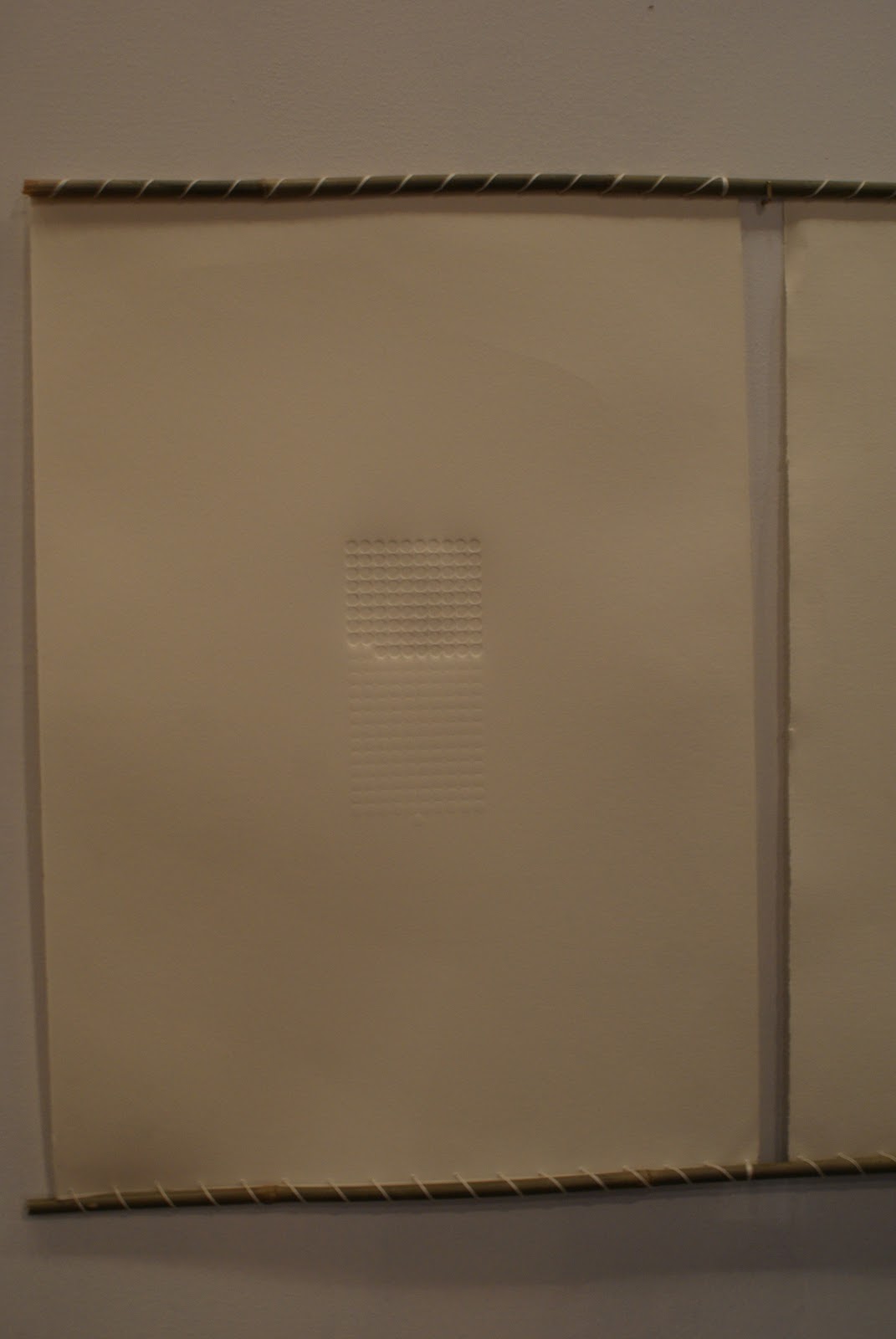
One Day- 20 000. This is a blind embossed print consisting of 20 000 ‘rivets’ of compressed paper, regimented in lines over 4 x A1 prints. In my mind 20 000 is a meaningless figure because it is so difficult to understand what 20 000 of anything together would look like. In this print, the number has meaning because it is graphically portrayed in a manner that is easy to make sense of. I make the calculation:

20 000 x 30 = 600 000

I then take the calculation further. The higher end of estimates for the number of Comfort Women is 200 000. (This number is conceivable by multiplying my print by 10) In brackets I then do the same calculation of multiplication by 30 to arrive at the staggering number of 6 million potential rapes on my hypothetical ‘One Day’

One Day- 80%. This is as the above but takes the fact that about 80% of the women were Korean Women.

One Day- 3. This print consists of two sheets of A1 paper blind embossed with the number of Korean women who registered as Military Comfort Women for the Korean Government to be able to fight for their rights with the Government of Japan. Those 88 or so, still alive are represented by concave embossing, while those that have died are honored with convex embossing  on the second sheet.

One Day- 4. Unlike the other 3 prints that are on off white paper, this print is snow white. It relates to the 35 Dutch women who were given justice after the war for being forced into Comfort Stations. It begs the question that if the rape of 35 Dutch women is a crime why not 200 Korean women or 20 000 or 200 000 Asian Women? The colour of the paper, denoting the inherent racism of the War Crimes Tribunal’s treatment of the Asian experience during World War II.

Each of the above prints are attached to bamboo at the top to hang rather than be framed. The bamboo is a direct reference to the story in ‘Cherry Blossoms Took My Life Away’, and binds the work to the other pieces through the thread of this testimony. The hanging is also in reference to the curtain that would hang in the door of each woman’s cell.


Notes on ‘Hayaku, Hayaku’:

There are three aspects to this piece, a decommissioned shell casing with painted inscription, a wreath of sugar paste flowers and the base from a Sony Television.

It illustrates the stories of Grandma Hong, Grandma Ha, Grandma Chung and Grandma Moon Pil Ki in their interviews with Dai Sil Kim-Gibson in her book ‘Silence Broken, Korean Comfort Women’, published by Mid-Prairie Books.

The shell casing is British, and reflects specifically and generally the role of Empire, Colonization and Politics in the story of the Comfort Women. Again, it represents the military and the masculine in dominance over the feminine. It tells the story of the women never being given time away. Even when they went to relive themselves or were menstruating, they were forced to continue.

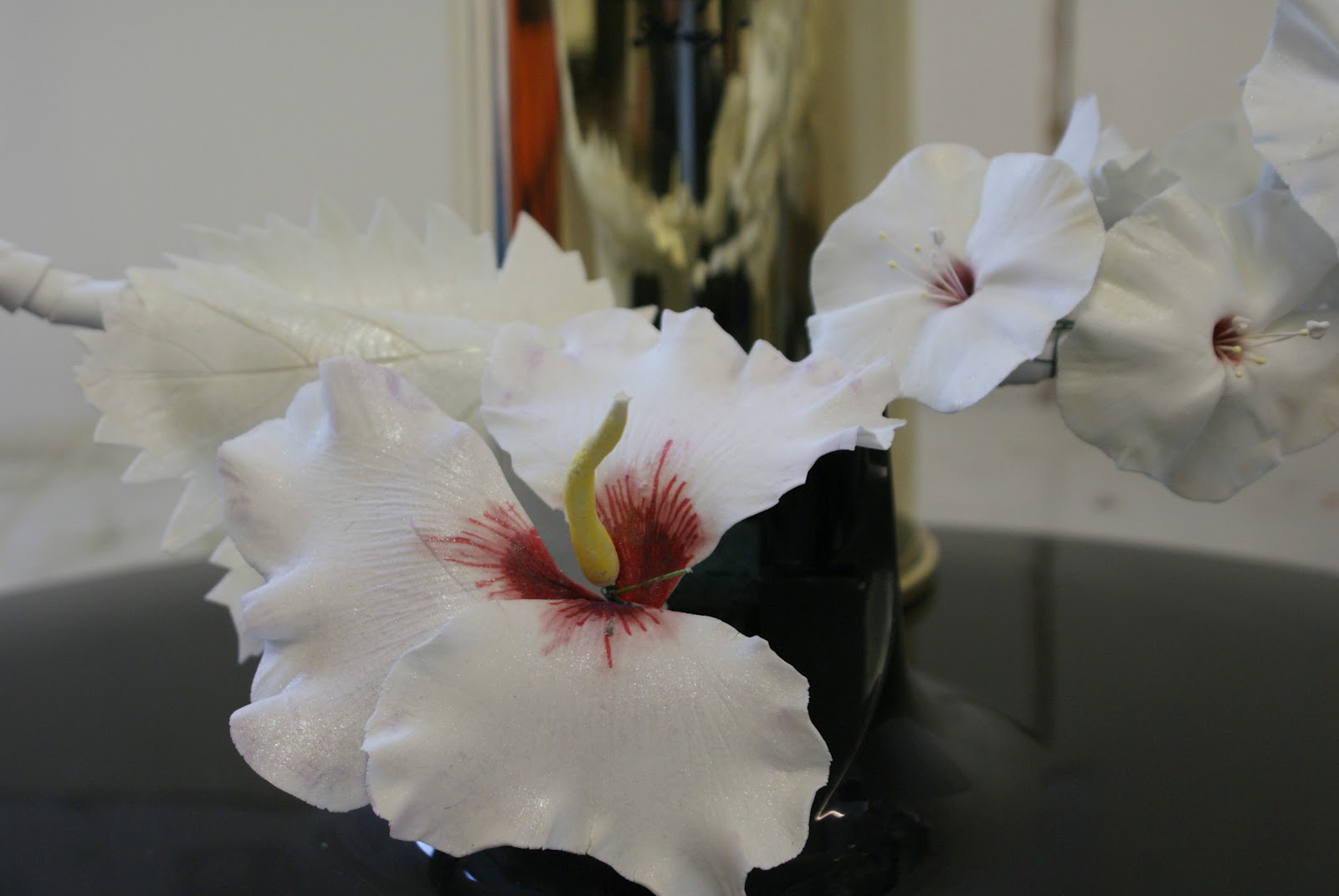
The sugar paste flowers carry on the motif of the Morning Glories and Rose of Sharon from the testimony of Grandma Shim Mi Ja in ‘Cherry Blossoms took my life away’. I learned to make these flowers from my partners Grandma at Easter, a woman of the same generation as the Comfort Women, who, like Grandma Shim Mi Ja, is incredibly talented with her hands. I asked her to teach me this skill to represent and make incredibly personal to me the feminine nature of this aspect of the piece. There are 100 Morning Glories (‘Grandma Chung cited 100 on weekends – violated these women) and one Rose of Sharon. It is an ‘Anthem to Doomed Youth’. The sugar paste is sweet and more fragile than porcelain. It is a metaphor for the sweetness and fragility of youth and virginity. The Rose of Sharon’s red centered petals are reflected in the blush in the heart of the Morning Glories. It is emblematic of the tainting by menstrual blood; the rape of the innocent and the loss of innocence. Each flower is dusted with silver to symbolize the sweat of the exertion and the perspiration of anticipation. It is circular as a wreath but also in the fact that the stream of men was never ending. The limp leaf to the left of the Rose of Sharon is a vine leaf. The Christian symbol for ‘Justice’ rendered impotent by the weight of sorrow and denial.

The base is black resin and again highly reflective. We see the sculpture reflected and distorted and contorted on its surface, as the issue has been by successive governments. It represents the modern technological achievements of both Japan and Korea, but begs the question ‘at what cost?’
 The Rose of Sharon

Re Exhibited at 'Phantasmagoria'


Last year, I was asked by a fellow artist and friend Ramon Salgado Touzon to re exhibit the work from my degree show at an exhibition that he was organising called 'Phantasmagoria' which was held in the O2 Shopping  Mall, Finchley Road, London. Here are some photographs from that exhibition:

Ramon and I take a break

Telling the story of the Comfort Women
as told in the work with:
Jonas, Daisy Delaney and Ramon


After months of hard work, Ramon gets a chance to sit down and appreciate all of his hard work for Phantasmagoria!


N.B. All of the works from my final degree show were either given away to publicise the plight of the Comfort Women or the large shell casing in 'Cherry Blossoms' was sold at a charity auction to aid the Mtaala Foundation which creates and supports education communities for vulnerable children and at-risk youth, including those affected by poverty, war, and HIV/AIDS.


http://www.mtaala.bigcartel.com/about


Links:

Article in Korean Herald 13/07/2012:

Arirang News interview with former US Ambassador to Korea:

Security Tight at ‘Comfort Women’ Photo Exhibit: Wall Street Journal:


http://beryl-pieces-asia.blogspot.co.uk/2011/05/japans-comfort-women-continuing-source.html

http://www.ibiblio.org/hyperwar/PTO/IMTFE/IMTFE-8.html

http://jesr.journal.fatih.edu.tr/AnEmergingTransnationalMovementinWomen%92sHumanRights.pdf